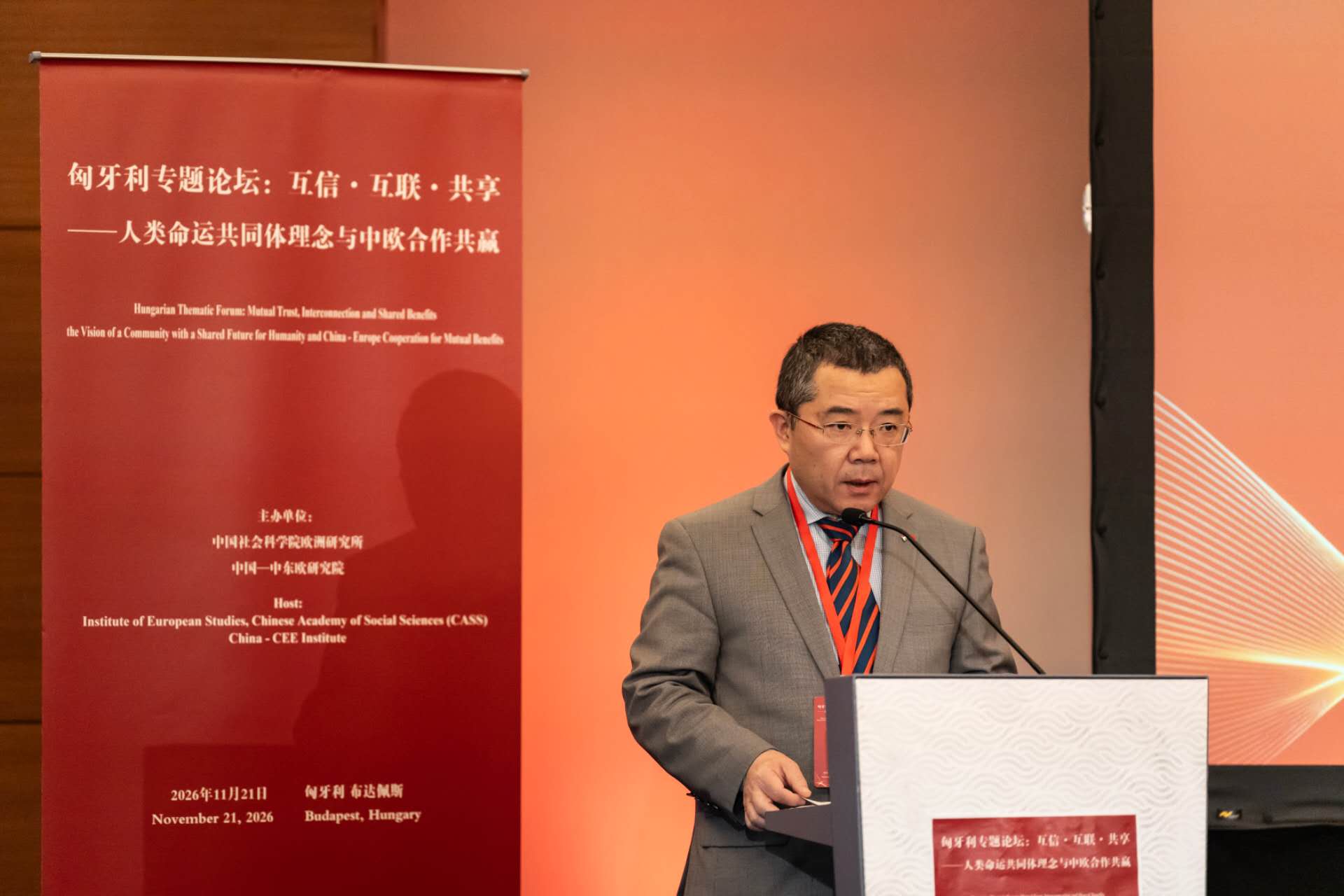








| Remarks by Ambassador GONG Tao At the Hungarian Thematic Forum: Mutual Trust, Interconnection and Shared Benefits: the Vision of a Community with a Shared Future for Humanity and China-Europe Cooperation for Mutual Benefits |
| 2026-11-25 22:42 |
|
Honorable Dr. Jin Minqing, Honorable Dr. Hamar Imre, Honorable Dr. Branislav Dordevic, Ladies and Gentlemen, Friends,
Good morning!
It is a great pleasure to join the International Forum on Overseas Study of Xi Jinping Thought on Socialism with Chinese Characteristics for a New Era.
The theme of this forum is “Mutual Trust, Interconnection and Shared Benefits: the Vision of a Community with a Shared Future for Humanity and China-Europe Cooperation for Mutual Benefits”. The experts and scholars present today are from different countries and diverse academic disciplines. This cross-disciplinary and international gathering is the most valuable asset of this forum. I look forward to fruitful exchanges of ideas that will allow us to explore issues in greater depth and gain deeper insights through discussion. At the invitation of the organizers, I would also like to share a few of my thoughts.
“Mutual Trust, Interconnection and Shared Benefits” is a topic of great relevance. Today, the world is undergoing profound changes and growing turbulence. We find ourselves in a world where geopolitical conflicts continue to flare up and drag on, where global economic growth remains anaemic, and where unilateralism and protectionism are on the rise. The more turbulent the world becomes, the more precious trust is; the more divided the international community becomes, the more indispensable connectivity is; and the greater the challenges we face, the more essential it is to share the benefits of development.
We need mutual trust. But where does trust come from?
Amid the turbulence and uncertainty in the world, what can truly inspire trust and confidence among countries is not grandiose promises, but tangible stability, consistency and predictability. Good governance requires perseverance and sustained commitment. Late last month, the Communist Party of China (CPC) convened the Fifth Plenary Session of its 20th Central Committee, which placed particular emphasis on persevering with full and rigorous Party self-governance, preserving the Party’s advanced nature and integrity, strengthening its unity and competencies, and leading the Chinese people in making further progress in Chinese modernization.
China’s major policies will remain stable and consistent. The Chinese economy has demonstrated strong resilience and vitality. From the First Five-Year Plan, launched in 1953, to the 15th Five-Year Plan, which kick-started this year, China has made full use of the strengths of its five-year plan system, consistently pursuing long-term development objectives with a clear vision and sustained commitment, carrying forward one blueprint after another. As a country of over 1.4 billion people, China’s ability to maintain long-term social stability and sustained economic development is in itself a major contribution to world peace, stability and prosperity.
China has been and always will be committed to the pursuit of peace and development. It opposes bloc confrontation while actively exploring new models of international relations. Relations among major countries have a profound bearing on the international landscape and global strategic stability. On the sidelines of the recently held APEC Economic Leaders’ Meeting, President Xi Jinping hosted a meeting with the Presidents of Russia and the United States. This marked the first time in history that the leaders of the three countries had met together. They exchanged views in depth on the current international situation and jointly issued the China-Russia-U.S. Heads of State Declaration toward Peace following the meeting, lending greater confidence to global strategic stability and international security. In the face of turbulence and challenges, we must build strength through confidence, overcome difficulties through cooperation, and bring greater certainty and positive energy to a turbulent and changing world.
We need connectivity. But what does connectivity really mean?
True connectivity means joining hands rather than letting go, and building bridges rather than erecting walls. As President Xi Jinping observed, “The economies move forward through connectivity and cooperation, but lose momentum when isolated from one another.” In the face of rising unilateralism and protectionism, China is working with partner countries to pursue high-quality Belt and Road cooperation, break down barriers to development through enhanced connectivity, and provide a practical pathway towards openness and development in a turbulent and changing world.
Hungary is a meeting point between East and West and a bridge connecting Europe and Asia. It was the first European country to sign a Belt and Road cooperation document with China. China-Hungary cooperation has delivered many tangible achievements in connectivity. In 2025, Hungary attracted 108 foreign investment projects, with a total investment value of approximately 7.069 billion euros. Chinese investment accounted for 3.97 billion euros, or nearly 57 percent of the total, making China Hungary’s largest source of foreign investment for the third consecutive year. This year, bilateral trade reached a new high, with imports and exports totaling 18.435 billion US dollars in the first three quarters, representing a year-on-year growth of 22.2 percent.
The Budapest-Belgrade Railway is an important intergovernmental cooperation project between China and Hungary. Thanks to the joint efforts of both sides, construction of the Hungarian section has been completed, and freight services commenced operation on February 27 this year, further strengthening Hungary’s position as a regional logistics hub. Work is also actively underway to launch passenger services, which will bring greater convenience to residents of cities along the route. Looking ahead, China will continue to champion openness, strengthen the bonds of cooperation and promote shared prosperity through connectivity.
We need to share benefits. But with whom do we share?
As the largest developing country, China has always viewed its own development within the broader historical context of human progress. We are ready to share the opportunities created by China’s development with Hungary, Europe and all our partner countries. During the 15th Five-Year Plan period, China will foster emerging industries and upgrade traditional ones. It will also further open up its services sector, bringing greater and more tangible market and innovation dividends. China stands ready to expand practical cooperation with Hungary and other countries in emerging fields, including new energy vehicles, artificial intelligence, the digital economy and green development, and to foster new engines of growth.
In China-Hungary relations, mutual respect, equality and mutual benefit have always been the basic principles guiding China’s approach to our bilateral relations. They are also the guiding principles for Chinese enterprises to put down roots in Hungary and give back to Hungarian society. Take BYD as an example. Although its plant in Szeged has yet to officially commence production, it has already become the largest taxpayer in the city this year, contributing more than 800 million forints in tax revenue to the local community. Once fully operational, the plant will make further contributions to local economic and social development.
In China-EU relations, China has always regarded the EU as a partner and pursued relations with Europe in good faith and with sincerity. Since the establishment of diplomatic relations between China and the EU more than 50 years ago, annual bilateral trade has grown more than 300-fold, while two-way investment stocks have approached 260 billion US dollars. A China that continues to grow and develop is not the source of Europe’s challenges. Rather, it is a partner and companion that can help Europe address them. China and the EU need to focus on areas of common ground, resolve economic and trade frictions through dialogue and consultation, and work towards mutual benefit and common development.
In the face of the deficits in peace, development, security and governance confronting the world today, China stands ready to work with all parties to actively implement the Global Development Initiative (GDI), Global Security Initiative (GSI), Global Civilization Initiative (GCI), and Global Governance Initiative (GGI) and practice the vision of global governance based on extensive consultation, joint contribution and shared benefits. Let us build strength through confidence, overcome challenges through cooperation, and work hand in hand towards a community with a shared future for mankind.
Thank you! |
|